Mathematical Induction
The process to establish the validity of an ordinary result involving natural numbers is the principle of mathematical induction.
Working Rule
Let n0 be a fixed integer. Suppose P (n) is a statement involving the natural number n and we wish to prove that P (n) is true for all n ≥n0.
1. Basic of Induction: P (n0) is true i.e. P (n) is true for n = n0.
2. Induction Step: Assume that the P (k) is true for n = k.
Then P (K+1) must also be true.
Then P (n) is true for all n ≥n0.
Example 1:
Prove the follo2wing by Mathematical Induction:
1 + 3 + 5 +.... + 2n - 1 = n2.
Solution: let us assume that.
P (n) = 1 + 3 + 5 +..... + 2n - 1 = n2.
For n = 1, 	P (1) = 1 = 12 = 1
It is true for n = 1................ (i)
Induction Step: For n = r,
P (r) = 1 + 3 + 5 +..... +2r-1 = r2 is true......................... (ii)
Adding 2r + 1 in both sides
       P (r + 1) = 1 + 3 + 5 +..... +2r-1 + 2r +1
                = r2 + (2r + 1) = r2 + 2r +1 = (r+1)2..................... (iii)
As P(r) is true. Hence P (r+1) is also true.
From (i), (ii) and (iii) we conclude that.
        1 + 3 + 5 +..... + 2n - 1 =n2 is true for n = 1, 2, 3, 4, 5 ....Hence Proved.
Example 2:
12 + 22 + 32 +.......+ n2 = 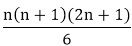
Solution: For n = 1,
P (1) = 12 =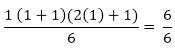 = 1
It is true for n = 1.
Induction Step: For n = r,................... (i)
P (r) = 12 + 22 + 32 +........ + r2 =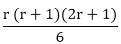 is true........... (ii)
Adding (r+1)2 on both sides, we get
P (r+1) = 12 + 22 + 32 +.......+ r2+ (r+1)2 =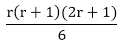 + (r+1)2
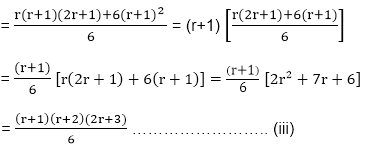
As P (r) is true, hence P (r+1) is true.
From (i), (ii) and (iii) we conclude that
12 + 22 + 32 +......+ n2=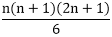 is true for n = 1, 2, 3, 4, 5 ..... Hence Proved.
Example3: Show that for any integer n
11n+2 + 122n+1 is divisible by 133.
Solution:
Let P (n) = 11n+2+122n+1
    For n = 1,
    P (1) = 113+123=3059=133 x 23
So, 133 divide P (1).................. (i)
Induction Step: For n = r,
P (r) = 11r+2+122r+1=133 x s............ (ii)
 Now, for n = r + 1,
P (r+1) = 11r+2+1+122(r)+3=11[133s-122r+1] + 144. 122r+1
        = 11 x 133s + 122r+1.133=133[11s+122r+1]=133 x t........... (iii)
As (i), (ii), and (iii) all are true, hence P (n) is divisible by 133.
Labels: Discrete, DSTL Unit-1
Discussion & Queries (<$I18NNumComments$>):
<$CommentPager$>
- <$I18NAtCommentTimeWithPermalink$>, <$I18NCommentAuthorSaid$>
<$CommentPager$>
<$BlogCommentBody$>
<$BlogCommentDeleteIcon$>