🎓 Computer Science & Engineering Portal

Master Engineering Disciplines with Structured Notes

Comprehensive academic lecture notes, exam-oriented unit summaries, laboratory manuals, and previous year question papers designed strictly for university students.

📑

University Syllabi

AKTU & AICTE aligned semester credit guidelines.

📝

Exam Question Papers

Previous 5 years solved university semester papers.

💡

Lab Manuals & Viva

Practical codes with outputs and interview questions.

Core Subjects & Units Hub

Click on any specific unit to immediately view its lecture notes below

🎨 Computer Graphics (CG)

Scan Conversion, Transformations, Viewing & Clipping.

Unit 1: Raster Scan & Bresenham→
Unit 2: 2D & 3D Transformations→
Unit 3: Viewing & Clipping→
Unit 4: Hidden Surface Elimination→
Unit 5: Curves & Animation→

🧠 Machine Learning (ML)

Regression, Decision Trees, SVM, Neural Nets & Clustering.

Unit 1: Supervised & Regression→
Unit 2: Decision Trees & SVM→
Unit 3: Unsupervised & K-Means→
Unit 4: Neural Networks→
Unit 5: Reinforcement Learning→

🤖 Artificial Intelligence (AI)

Search Algorithms, First Order Logic, Expert Systems.

Unit 1: Propositional Logic→
Unit 2: Probabilistic Reasoning→
Unit 3: State Space Search & A*→
Unit 4: First Order Predicate Logic→
Unit 5: Expert Systems→

🗄️ Database Management

ER-Modeling, SQL Queries, Normalization and ACID.

Unit 1: ER Model & Attributes→
Unit 2: Normalization (1NF-BCNF)→
Unit 3: ACID & Concurrency→
Unit 4: Relational Algebra & SQL→
Unit 5: NoSQL & Advanced DB→

🌲 Data Structures (DSA)

Arrays, Linked Lists, Trees, Graphs & Sorting.

Unit 1: Arrays & Recursion→
Unit 2: Stacks, Queues & Postfix→
Unit 3: Binary Trees & BST→
Unit 4: Graphs (BFS, DFS)→
Unit 5: Sorting & Hashing→

⚡ Operating Systems (OS)

Process Scheduling, Deadlocks, Virtual Memory & Disks.

Unit 1: Process States & Threads→
Unit 2: CPU Scheduling→
Unit 3: Deadlocks & Banker's Algo→
Unit 4: Virtual Memory & Paging→
Unit 5: File & Disk Management→

🌐 Computer Networks

OSI Models, Subnetting, Routing and TCP Handshake.

Unit 1: OSI vs TCP/IP Models→
Unit 2: Data Link Layer & Framing→
Unit 3: IPv4 & Subnetting→
Unit 4: Transport Layer (TCP)→
Unit 5: Application Layer (DNS)→

⚙ Design of Algorithms

Asymptotic Notations, Divide & Conquer, Greedy.

Unit 1: Time Complexity→
Unit 2: Divide & Conquer→
Unit 3: Dynamic Programming→
Unit 4: Greedy Approach→
Unit 5: Backtracking→
Viewing All Lectures

Compliance with Design

Compliance with Design

Compliance Testing is performed to maintain and validate the compliant state for the life of the software. Every industry has a regulatory and compliance board that protects the end users.

Software compliance refers to how well an application obeys the rules in a standard. To achieve software compliance, you might also have to, for example, produce certain types of documentation or add security testing at more points in your software development life cycle.

Checklists:

  • Professionals, who are knowledgeable and experienced, who understand the compliance must be retained.
  • Understanding the risks and impacts of being non-compliant
  • Document the processes and follow them
  • Perform an internal audit and follow with an action plan to fix the issues

Coding Standards

Coding:

  • The objective of the coding phase is to transform the design of a system into code in a high-level language and then to unit test this code. 
  • Good software development organizations normally require their programmers to adhere to some well-defined and standard style of coding called coding standards.

Coding Standards:

  1. A coding standard gives a uniform appearance to the codes written by different engineers.
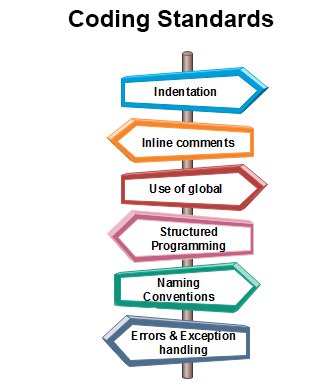
  1. It enhances code understanding
  2. It encourages good programming practice
  3. Agree upon standards for coding styles
  4. Promotes ease of understanding and uniformity
  5. No idiosyncratic quirks that could complicate understanding and refactoring by the entire team.

Coding Guidelines:

  1. Line length
  2. Spacing
  3. Code is well documented
  4. Length not exceed 10 source lines
  5. Don’t use goto statement
  6. Inline comments
  7. Error messages

Labels: ,

Discussion & Queries (<$I18NNumComments$>):

<$CommentPager$>
<$I18NAtCommentTimeWithPermalink$>, <$I18NCommentAuthorSaid$>

<$BlogCommentBody$>

<$BlogCommentDeleteIcon$>
<$CommentPager$>