πŸŽ“ Computer Science & Engineering Portal

Master Engineering Disciplines with Structured Notes

Comprehensive academic lecture notes, exam-oriented unit summaries, laboratory manuals, and previous year question papers designed strictly for university students.

πŸ“‘

University Syllabi

AKTU & AICTE aligned semester guidelines.

πŸ“

Exam Question Papers

Previous 5 years solved university papers.

πŸ’‘

Lab Manuals & Viva

Practical codes with outputs & interview Qs.

Core Subjects & Units Hub

Click on any specific unit to immediately view its lecture notes below

Viewing All Lectures

Radix Sort Algorithm

Radix sort is the linear sorting algorithm that is used for integers. In Radix sort, there is digit by digit sorting is performed that is started from the least significant digit to the most significant digit.

The process of radix sort works similar to the sorting of students names, according to the alphabetical order. In this case, there are 26 radix formed due to the 26 alphabets in English. In the first pass, the names of students are grouped according to the ascending order of the first letter of their names. After that, in the second pass, their names are grouped according to the ascending order of the second letter of their name. And the process continues until we find the sorted list.

Now, let's see the algorithm of Radix sort.

Algorithm

radixSort(arr)  
max = largest element in the given array  
d = number of digits in the largest element (or, max)  
Now, create d buckets of size 0 - 9  
for i -> 0 to d  
sort the array elements using counting sort (or any stable sort) according to the digits at  
the ith place

Working of Radix sort Algorithm

Now, let's see the working of Radix sort Algorithm.

The steps used in the sorting of radix sort are listed as follows -

  • First, we have to find the largest element (suppose max) from the given array. Suppose 'x' be the number of digits in max. The 'x' is calculated because we need to go through the significant places of all elements.
  • After that, go through one by one each significant place. Here, we have to use any stable sorting algorithm to sort the digits of each significant place.

Now let's see the working of radix sort in detail by using an example. To understand it more clearly, let's take an unsorted array and try to sort it using radix sort. It will make the explanation clearer and easier.

Radix Sort Algorithm

In the given array, the largest element is 736 that have 3 digits in it. So, the loop will run up to three times (i.e., to the hundreds place). That means three passes are required to sort the array.

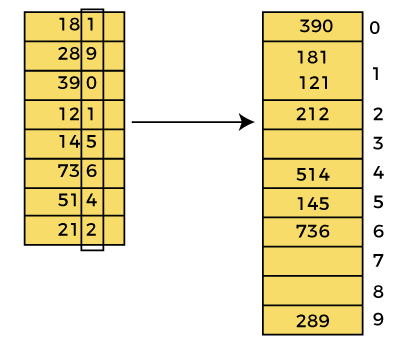
Now, first sort the elements on the basis of unit place digits (i.e., x = 0). Here, we are using the counting sort algorithm to sort the elements.

Pass 1:

In the first pass, the list is sorted on the basis of the digits at 0's place.
Radix Sort Algorithm

After the first pass, the array elements are -

Radix Sort Algorithm

Pass 2:

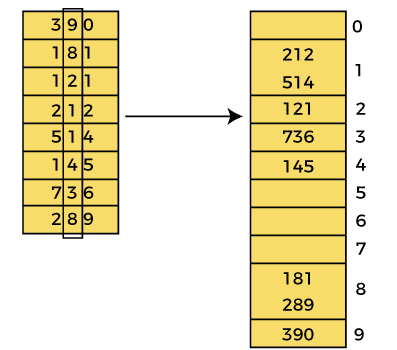
In this pass, the list is sorted on the basis of the next significant digits (i.e., digits at 10th place).
Radix Sort Algorithm

After the second pass, the array elements are -

Radix Sort Algorithm

Pass 3:

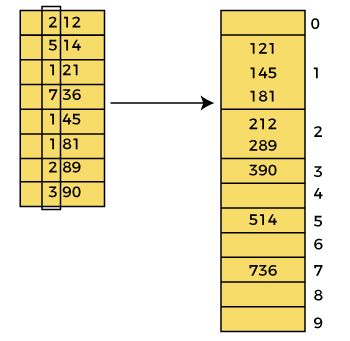
In this pass, the list is sorted on the basis of the next significant digits (i.e., digits at 100th place).
Radix Sort Algorithm

After the third pass, the array elements are -

Radix Sort Algorithm

Now, the array is sorted in ascending order.

Radix sort complexity

Now, let's see the time complexity of Radix sort in best case, average case, and worst case. We will also see the space complexity of Radix sort.

1. Time Complexity

Case

Time Complexity

Best Case

Ξ©(n+k)

Average Case

ΞΈ(nk)

Worst Case

O(nk)

  • Best Case Complexity - It occurs when there is no sorting required, i.e. the array is already sorted. The best-case time complexity of Radix sort is Ξ©(n+k).
  • Average Case Complexity - It occurs when the array elements are in jumbled order that is not properly ascending and not properly descending. The average case time complexity of Radix sort is ΞΈ(nk).
  • Worst Case Complexity - It occurs when the array elements are required to be sorted in reverse order. That means suppose you have to sort the array elements in ascending order, but its elements are in descending order. The worst-case time complexity of Radix sort is O(nk).

Radix sort is a non-comparative sorting algorithm that is better than the comparative sorting algorithms. It has linear time complexity that is better than the comparative algorithms with complexity O(n logn).

2. Space Complexity

Space Complexity

O(n + k)

Stable

YES

  • The space complexity of Radix sort is O(n + k).

Implementation of Radix sort

Now, let's see the programs of Radix sort in different programming languages.

Program: Write a program to implement Radix sort in C language.

#include <stdio.h>  
  
int getMax(int a[], int n) {  
   int max = a[0];  
   for(int i = 1; i<n; i++) {  
      if(a[i] > max)  
         max = a[i];  
   }  
   return max; //maximum element from the array  
}  
  
void countingSort(int a[], int n, int place) // function to implement counting sort  
{  
  int output[n + 1];  
  int count[10] = {0};    
  
  // Calculate count of elements  
  for (int i = 0; i < n; i++)  
    count[(a[i] / place) % 10]++;  
      
  // Calculate cumulative frequency  
  for (int i = 1; i < 10; i++)  
    count[i] += count[i - 1];  
  
  // Place the elements in sorted order  
  for (int i = n - 1; i >= 0; i--) {  
    output[count[(a[i] / place) % 10] - 1] = a[i];  
    count[(a[i] / place) % 10]--;  
  }  
  
  for (int i = 0; i < n; i++)  
    a[i] = output[i];  
}  
  
// function to implement radix sort  
void radixsort(int a[], int n) {  
   
  // get maximum element from array  
  int max = getMax(a, n);  
  
  // Apply counting sort to sort elements based on place value  
  for (int place = 1; max / place > 0; place *= 10)  
    countingSort(a, n, place);  
}  
  
// function to print array elements  
void printArray(int a[], int n) {  
  for (int i = 0; i < n; ++i) {  
    printf("%d  ", a[i]);  
  }  
  printf("\n");  
}  
  
int main() {  
  int a[] = {181, 289, 390, 121, 145, 736, 514, 888, 122};  
  int n = sizeof(a) / sizeof(a[0]);  
  printf("Before sorting array elements are - \n");  
  printArray(a,n);  
  radixsort(a, n);  
  printf("After applying Radix sort, the array elements are - \n");  
  printArray(a, n);  
}  

Output:

After the execution of the above code, the output will be -

Radix Sort Algorithm

Labels: ,

Heap Sort Algorithm

Heap sort processes the elements by creating the min-heap or max-heap using the elements of the given array. Min-heap or max-heap represents the ordering of array in which the root element represents the minimum or maximum element of the array.

Heap sort basically recursively performs two main operations -

  • Build a heap H, using the elements of array.
  • Repeatedly delete the root element of the heap formed in 1st phase.

Before knowing more about the heap sort, let's first see a brief description of Heap.

What is a heap?

A heap is a complete binary tree, and the binary tree is a tree in which the node can have the utmost two children. A complete binary tree is a binary tree in which all the levels except the last level, i.e., leaf node, should be completely filled, and all the nodes should be left-justified.

What is heap sort?

Heapsort is a popular and efficient sorting algorithm. The concept of heap sort is to eliminate the elements one by one from the heap part of the list, and then insert them into the sorted part of the list.

Heapsort is the in-place sorting algorithm.

Now, let's see the algorithm of heap sort.

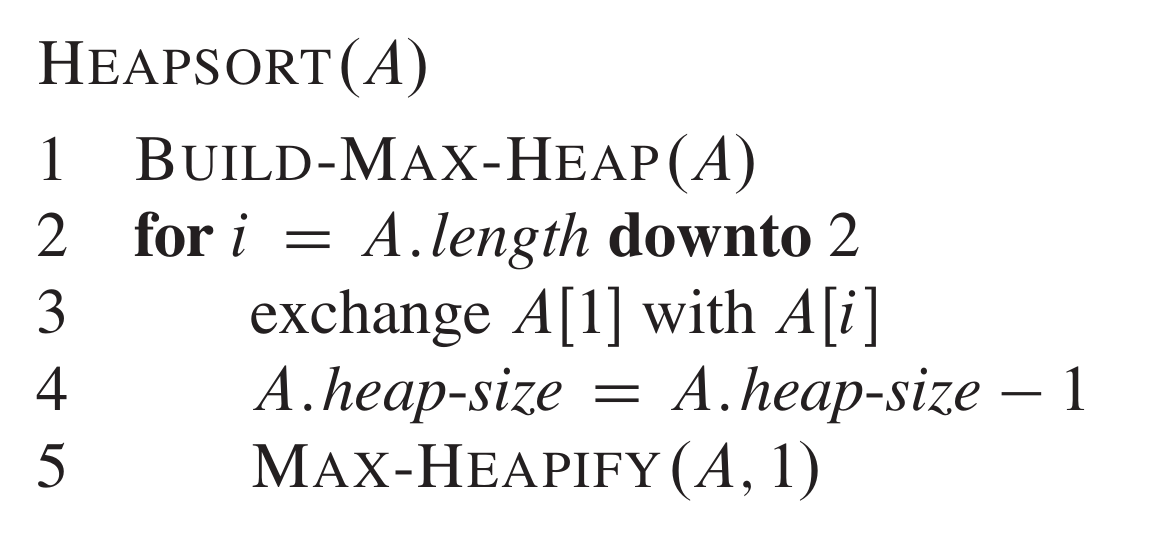
Algorithm

Heaps and Heap Sort Algorithm. Alright, So you at last decided to… | by  Palak | Medium

BuildMaxHeap(arr)

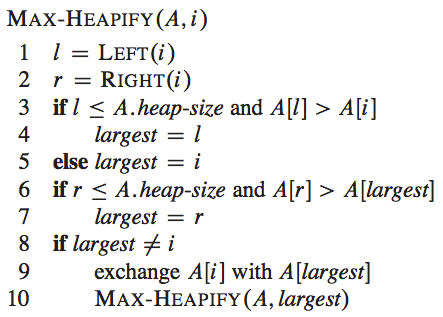
Heaps and Heap Sort Algorithm. Alright, So you at last decided to… | by  Palak | Medium

MaxHeapify(arr,i)

Cormen&#39;s heap sort structure - Stack Overflow

578 - Building a Max Heap

Working of Heap sort Algorithm

Now, let's see the working of the Heapsort Algorithm.

In heap sort, basically, there are two phases involved in the sorting of elements. By using the heap sort algorithm, they are as follows -

  • The first step includes the creation of a heap by adjusting the elements of the array.
  • After the creation of heap, now remove the root element of the heap repeatedly by shifting it to the end of the array, and then store the heap structure with the remaining elements.

Now let's see the working of heap sort in detail by using an example. To understand it more clearly, let's take an unsorted array and try to sort it using heap sort. It will make the explanation clearer and easier.

Heap Sort Algorithm

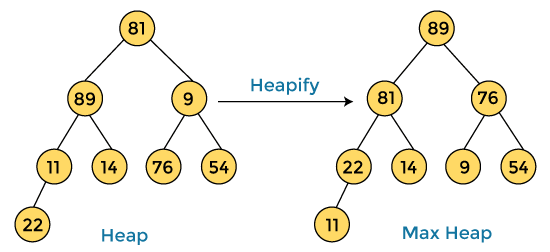
First, we have to construct a heap from the given array and convert it into max heap.

Heap Sort Algorithm

After converting the given heap into max heap, the array elements are -

Heap Sort Algorithm

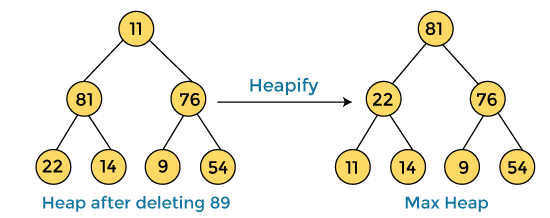
Next, we have to delete the root element (89) from the max heap. To delete this node, we have to swap it with the last node, i.e. (11). After deleting the root element, we again have to heapify it to convert it into max heap.

Heap Sort Algorithm

After swapping the array element 89 with 11, and converting the heap into max-heap, the elements of array are -

Heap Sort Algorithm

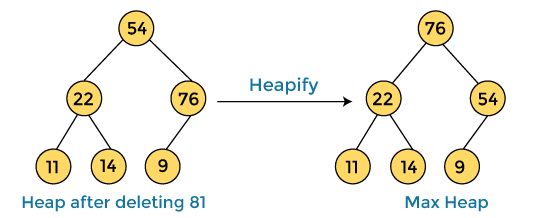
In the next step, again, we have to delete the root element (81) from the max heap. To delete this node, we have to swap it with the last node, i.e. (54). After deleting the root element, we again have to heapify it to convert it into max heap.

Heap Sort Algorithm

After swapping the array element 81 with 54 and converting the heap into max-heap, the elements of array are -

Heap Sort Algorithm

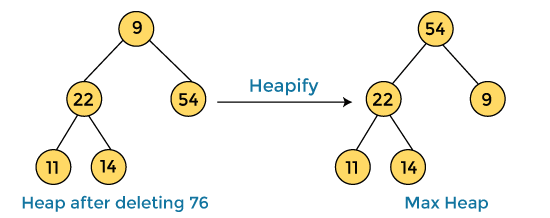
In the next step, we have to delete the root element (76) from the max heap again. To delete this node, we have to swap it with the last node, i.e. (9). After deleting the root element, we again have to heapify it to convert it into max heap.

Heap Sort Algorithm

After swapping the array element 76 with 9 and converting the heap into max-heap, the elements of array are -

Heap Sort Algorithm

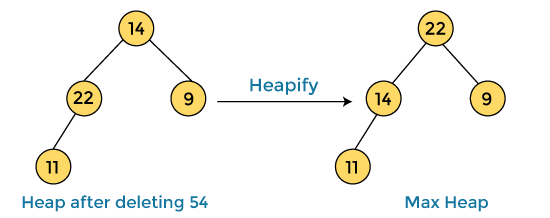
In the next step, again we have to delete the root element (54) from the max heap. To delete this node, we have to swap it with the last node, i.e. (14). After deleting the root element, we again have to heapify it to convert it into max heap.

Heap Sort Algorithm

After swapping the array element 54 with 14 and converting the heap into max-heap, the elements of array are -

Heap Sort Algorithm

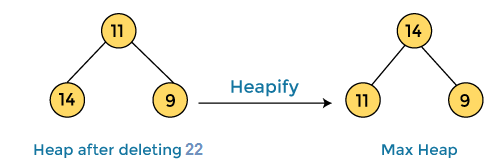
In the next step, again we have to delete the root element (22) from the max heap. To delete this node, we have to swap it with the last node, i.e. (11). After deleting the root element, we again have to heapify it to convert it into max heap.

Heap Sort Algorithm

After swapping the array element 22 with 11 and converting the heap into max-heap, the elements of array are -

Heap Sort Algorithm

In the next step, again we have to delete the root element (14) from the max heap. To delete this node, we have to swap it with the last node, i.e. (9). After deleting the root element, we again have to heapify it to convert it into max heap.

Heap Sort Algorithm

After swapping the array element 14 with 9 and converting the heap into max-heap, the elements of array are -

Heap Sort Algorithm

In the next step, again we have to delete the root element (11) from the max heap. To delete this node, we have to swap it with the last node, i.e. (9). After deleting the root element, we again have to heapify it to convert it into max heap.

Heap Sort Algorithm

After swapping the array element 11 with 9, the elements of array are -

Heap Sort Algorithm

Now, heap has only one element left. After deleting it, heap will be empty.

Heap Sort Algorithm

After completion of sorting, the array elements are -

Heap Sort Algorithm

Now, the array is completely sorted.

Heap sort complexity

Now, let's see the time complexity of Heap sort in the best case, average case, and worst case. We will also see the space complexity of Heapsort.

1. Time Complexity

Case

Time Complexity

Best Case

O(n logn)

Average Case

O(n log n)

Worst Case

O(n log n)

  • Best Case Complexity - It occurs when there is no sorting required, i.e. the array is already sorted. The best-case time complexity of heap sort is O(n logn).
  • Average Case Complexity - It occurs when the array elements are in jumbled order that is not properly ascending and not properly descending. The average case time complexity of heap sort is O(n log n).
  • Worst Case Complexity - It occurs when the array elements are required to be sorted in reverse order. That means suppose you have to sort the array elements in ascending order, but its elements are in descending order. The worst-case time complexity of heap sort is O(n log n).

The time complexity of heap sort is O(n logn) in all three cases (best case, average case, and worst case). The height of a complete binary tree having n elements is logn.

2. Space Complexity

Space Complexity

O(n)

Stable

No

  • The space complexity of Heap sort is O(1).

Implementation of Heapsort

Now, let's see the programs of Heap sort in different programming languages.

Program: Write a program to implement heap sort in C language.

#include <stdio.h>  
/* function to heapify a subtree. Here 'i' is the   
index of root node in array a[], and 'n' is the size of heap. */   
void heapify(int a[], int n, int i)  
{  
    int largest = i; // Initialize largest as root  
    int left = 2 * i + 1; // left child  
    int right = 2 * i + 2; // right child  
    // If left child is larger than root  
    if (left < n && a[left] > a[largest])  
        largest = left;  
    // If right child is larger than root  
    if (right < n && a[right] > a[largest])  
        largest = right;  
    // If root is not largest  
    if (largest != i) {  
        // swap a[i] with a[largest]  
        int temp = a[i];  
        a[i] = a[largest];  
        a[largest] = temp;  
          
        heapify(a, n, largest);  
    }  
}  
/*Function to implement the heap sort*/  
void heapSort(int a[], int n)  
{  
    for (int i = n / 2 - 1; i >= 0; i--)  
        heapify(a, n, i);  
    // One by one extract an element from heap  
    for (int i = n - 1; i >= 0; i--) {  
        /* Move current root element to end*/  
        // swap a[0] with a[i]  
        int temp = a[0];  
        a[0] = a[i];  
        a[i] = temp;  
          
        heapify(a, i, 0);  
    }  
}  
/* function to print the array elements */  
void printArr(int arr[], int n)  
{  
    for (int i = 0; i < n; ++i)  
    {  
        printf("%d", arr[i]);  
        printf(" ");  
    }  
          
}  
int main()  
{  
    int a[] = {48, 10, 23, 43, 28, 26, 1};  
    int n = sizeof(a) / sizeof(a[0]);  
    printf("Before sorting array elements are - \n");  
    printArr(a, n);  
    heapSort(a, n);  
    printf("\nAfter sorting array elements are - \n");    
    printArr(a, n);  
    return 0;  
}  

Output

Heap Sort Algorithm

Labels: ,