🎓 Computer Science & Engineering Portal

Master Engineering Disciplines with Structured Notes

Comprehensive academic lecture notes, exam-oriented unit summaries, laboratory manuals, and previous year question papers designed strictly for university students.

📑

University Syllabi

AKTU & AICTE aligned semester credit guidelines.

📝

Exam Question Papers

Previous 5 years solved university semester papers.

💡

Lab Manuals & Viva

Practical codes with outputs and interview questions.

Core Subjects & Units Hub

Click on any specific unit to immediately view its lecture notes below

🎨 Computer Graphics (CG)

Scan Conversion, Bresenham Line & Circle, 2D/3D Transformations, Viewing & Clipping.

Unit 1: Raster Scan, DDA & Bresenham →
Unit 2: 2D & 3D Transformations →
Unit 3: Sutherland-Hodgman & Clipping →
Unit 4: Hidden Surface Elimination →

🧠 Machine Learning (ML / MLT)

Supervised/Unsupervised Learning, Regression, Decision Trees, SVM, Neural Nets & Clustering.

Unit 1: Linear & Logistic Regression →
Unit 2: Decision Trees & Support Vector (SVM) →
Unit 3: K-Means & Dimensionality Reduction →
Unit 4: Neural Networks & Gradient Descent →

🤖 Artificial Intelligence (AI)

Search Algorithms, First Order Logic, Probabilistic Reasoning, Expert Systems & Robotics.

Unit 1: Propositional Logic & Connectives →
Unit 2: Probabilistic Reasoning & Uncertainty →
Unit 3: State Space Search & Heuristics →
Unit 4: First Order Predicate Logic (FOL) →

🗄️ Database Management (DBMS)

ER-Modeling, Relational Algebra, SQL Queries, Normalization (1NF-BCNF) and ACID Transactions.

Unit 1: ER Model, Entities & Attributes →
Unit 2: Functional Dependencies & 1NF to BCNF →
Unit 3: ACID Properties & Concurrency Control →
Unit 4: Relational Algebra & Complex SQL Joins →

🌲 Data Structures & Algorithms

Arrays, Linked Lists, Stacks, Queues, Binary Trees, Graphs, Sorting & Asymptotic Analysis.

Unit 1: Arrays, Matrices & Recursion →
Unit 2: Stacks, Queues & Infix-to-Postfix →
Unit 3: Binary Trees, BST & AVL Rotations →
Unit 4: Graphs (BFS, DFS, Dijkstra, MST) →

⚡ Operating Systems

Process Scheduling, Deadlocks, Synchronization, Virtual Memory, Paging and Disk Management.

Unit 1: Process States, PCB & Multi-Threading →
Unit 2: CPU Scheduling (FCFS, SJF, RR) →
Unit 3: Deadlocks, Semaphores & Banker's Algo →
Unit 4: Virtual Memory, Paging & Disk Scheduling →

🌐 Computer Networks

OSI & TCP/IP Models, Error Detection, IPv4 Subnetting, Routing Protocols and TCP Handshake.

Unit 1: OSI vs TCP/IP Protocol Architectures →
Unit 2: Data Link Layer, Framing & Sliding Window →
Unit 3: IPv4 Addressing, Subnetting & Routing →
Unit 4: Transport Layer (TCP 3-Way Handshake) →

⚙️ Design of Algorithms (DAA)

Asymptotic Notations, Divide & Conquer, Dynamic Programming, Greedy Approach & Backtracking.

Unit 1: Time Complexity, Master's Theorem →
Unit 2: 0/1 Knapsack & Dynamic Programming →
Unit 3: Greedy Methods & Graph Algorithms →
Viewing All Lectures

Data model Schema and Instance

Data model Schema and Instance

  • The data which is stored in the database at a particular moment of time is called an instance of the database.
  • The overall design of a database is called schema.
  • A database schema is the skeleton structure of the database. It represents the logical view of the entire database.
  • A schema contains schema objects like table, foreign key, primary key, views, columns, data types, stored procedure, etc.
  • A database schema can be represented by using the visual diagram. That diagram shows the database objects and relationship with each other.
  • A database schema is designed by the database designers to help programmers whose software will interact with the database. The process of database creation is called data modeling.

A schema diagram can display only some aspects of a schema like the name of record type, data type, and constraints. Other aspects can't be specified through the schema diagram. For example, the given figure neither show the data type of each data item nor the relationship among various files.

In the database, actual data changes quite frequently. For example, in the given figure, the database changes whenever we add a new grade or add a student. The data at a particular moment of time is called the instance of the database.
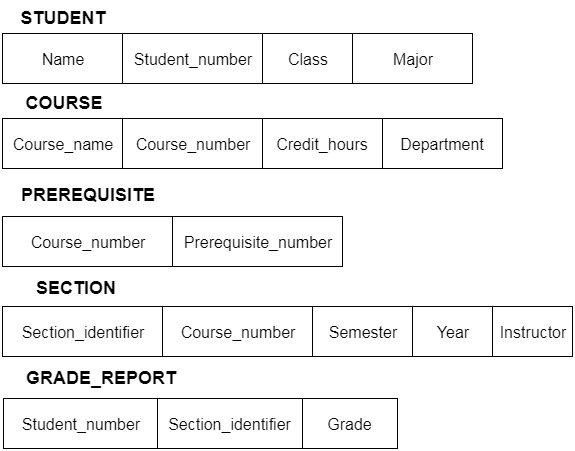
DBMS Data model Schema and Instance

Labels: ,

Discussion & Queries (<$I18NNumComments$>):

<$CommentPager$>
<$I18NAtCommentTimeWithPermalink$>, <$I18NCommentAuthorSaid$>

<$BlogCommentBody$>

<$BlogCommentDeleteIcon$>
<$CommentPager$>