Process-to-Process Delivery
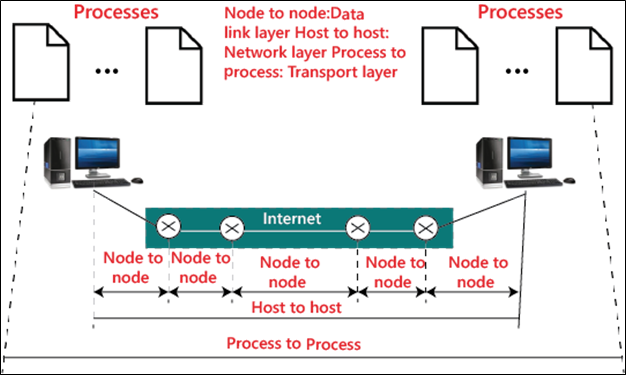
Process-to-Process Delivery: The data link layer is responsible for delivery of frames between two neighboring nodes over a link. This is called node-to-node delivery. The network layer is responsible for delivery of datagrams between two hosts. This is called host-to-host delivery. Real communication takes place between two processes (application programs). We need process-to-process delivery. The transport layer is responsible for process-to-process delivery-the delivery of a packet, part of a message, from one process to another. Figure shows these three types of deliveries and their domains
Client/Server Paradigm
Although there are several ways to achieve process-to-process communication, the most common one is through the client/server paradigm. A process on the local host, called a client, needs services from a process usually on the remote host, called a server. Both processes (client and server) have the same name. For example, to get the day and time from a remote machine, we need a Daytime client process running on the local host and a Daytime server process running on a remote machine. For communication, we must define the following:
1. Local host
2. Local process
3. Remote host
4. Remote process
Discussion & Queries (<$I18NNumComments$>):
<$CommentPager$>
- <$I18NAtCommentTimeWithPermalink$>, <$I18NCommentAuthorSaid$>
<$CommentPager$>
<$BlogCommentBody$>
<$BlogCommentDeleteIcon$>