I/O Channels and its types
I/O Channels and its types
I/O Channel is an extension of the DMA concept. It has ability to execute I/O instructions using special-purpose processor on I/O channel and complete control over I/O operations. Processor does not execute I/O instructions itself. Processor initiates I/O transfer by instructing the I/O channel to execute a program in memory.
Program specifies – Device or devices, Area or areas of memory, Priority, and Error condition actions
Types of I/O Channels :

1. Selector Channel :
Selector channel controls multiple high-speed devices. It is dedicated to the transfer of data with one of the devices. In selector channel, each device is handled by a controller or I/O module. It controls the I/O controllers shown in the figure.

2. Multiplexer Channel :
Multiplexer channel is a DMA controller that can handle multiple devices at the same time. It can do block transfers for several devices at once.
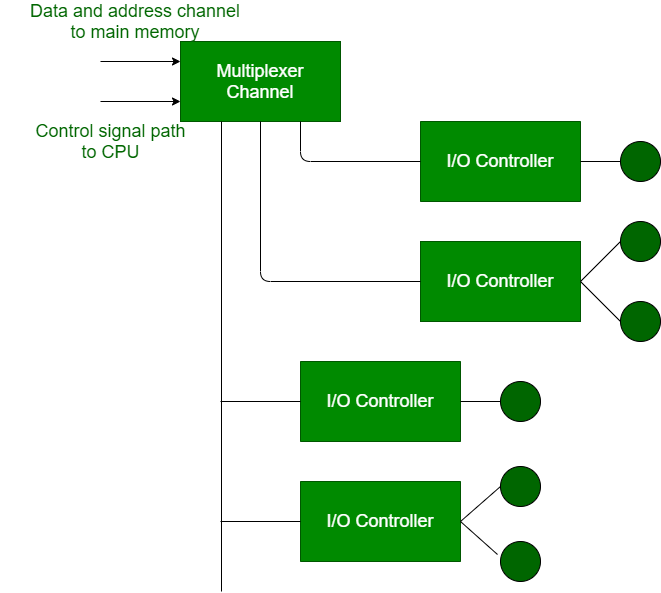
Two types of multiplexers are used in this channel:
- Byte Multiplexer –It is used for low-speed devices. It transmits or accepts characters. Interleaves bytes from several devices.
- Block Multiplexer –It accepts or transmits block of characters. Interleaves blocks of bytes from several devices. Used for high-speed devices.
Discussion & Queries (<$I18NNumComments$>):
<$CommentPager$>
- <$I18NAtCommentTimeWithPermalink$>, <$I18NCommentAuthorSaid$>
<$CommentPager$>
<$BlogCommentBody$>
<$BlogCommentDeleteIcon$>