LALR (1) Parsing
LALR (1) Parsing:
- LALR refers to the lookahead LR. To construct the LALR (1) parsing table, we use the canonical collection of LR (1) items.
- In the LALR (1) parsing, the LR (1) items which have same productions but different look ahead are combined to form a single set of items
- LALR (1) parsing is same as the CLR (1) parsing, only difference in the parsing table.
Example
LALR ( 1 ) Grammar
S → AA
A → aA
A → b
Add Augment Production, insert '•' symbol at the first position for every production in G and also add the look ahead.
S` → •S, $
S → •AA, $
A → •aA, a/b
A → •b, a/b
I0 State:
Add Augment production to the I0 State and Compute the ClosureL
I0 = Closure (S` → •S)
Add all productions starting with S in to I0 State because "•" is followed by the non-terminal. So, the I0 State becomes
I0 = S` → •S, $
S → •AA, $
Add all productions starting with A in modified I0 State because "•" is followed by the non-terminal. So, the I0 State becomes.
I0= S` → •S, $
S → •AA, $
A → •aA, a/b
A → •b, a/b
I1= Go to (I0, S) = closure (S` → S•, $) = S` → S•, $
I2= Go to (I0, A) = closure ( S → A•A, $ )
Add all productions starting with A in I2 State because "•" is followed by the non-terminal. So, the I2 State becomes
I2= S → A•A, $
A → •aA, $
A → •b, $
I3= Go to (I0, a) = Closure ( A → a•A, a/b )
Add all productions starting with A in I3 State because "•" is followed by the non-terminal. So, the I3 State becomes
I3= A → a•A, a/b
A → •aA, a/b
A → •b, a/b
Go to (I3, a) = Closure (A → a•A, a/b) = (same as I3)
Go to (I3, b) = Closure (A → b•, a/b) = (same as I4)
I4= Go to (I0, b) = closure ( A → b•, a/b) = A → b•, a/b
I5= Go to (I2, A) = Closure (S → AA•, $) =S → AA•, $
I6= Go to (I2, a) = Closure (A → a•A, $)
Add all productions starting with A in I6 State because "•" is followed by the non-terminal. So, the I6 State becomes
I6 = A → a•A, $
A → •aA, $
A → •b, $
Go to (I6, a) = Closure (A → a•A, $) = (same as I6)
Go to (I6, b) = Closure (A → b•, $) = (same as I7)
I7= Go to (I2, b) = Closure (A → b•, $) = A → b•, $
I8= Go to (I3, A) = Closure (A → aA•, a/b) = A → aA•, a/b
I9= Go to (I6, A) = Closure (A → aA•, $) A → aA•, $
If we analyze then LR (0) items of I3 and I6 are same but they differ only in their lookahead.
I3 = { A → a•A, a/b
A → •aA, a/b
A → •b, a/b
}
I6= { A → a•A, $
A → •aA, $
A → •b, $
}
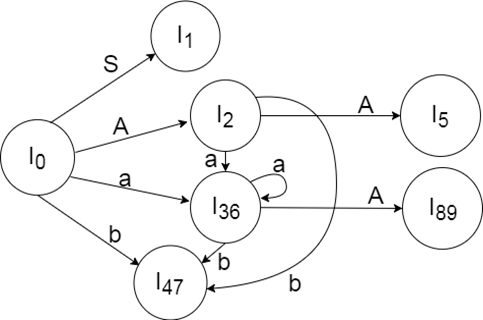
Clearly I3 and I6 are same in their LR (0) items but differ in their lookahead, so we can combine them and called as I36.
I36 = { A → a•A, a/b/$
A → •aA, a/b/$
A → •b, a/b/$
}
The I4 and I7 are same but they differ only in their look ahead, so we can combine them and called as I47.
I47 = {A → b•, a/b/$}
The I8 and I9 are same but they differ only in their look ahead, so we can combine them and called as I89.
I89 = {A → aA•, a/b/$}
Drawing DFA:
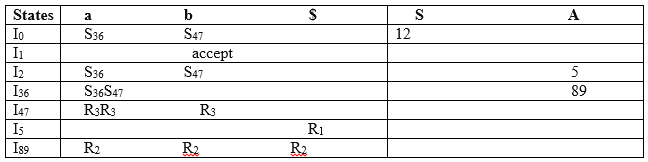
LALR (1) Parsing table:
Labels: CD Unit-2, Compiler Design
Discussion & Queries (<$I18NNumComments$>):
<$CommentPager$>
- <$I18NAtCommentTimeWithPermalink$>, <$I18NCommentAuthorSaid$>
<$CommentPager$>
<$BlogCommentBody$>
<$BlogCommentDeleteIcon$>