LEX
LEX
- Lex is a program that generates lexical analyzer. It is used with YACC parser generator.
- The lexical analyzer is a program that transforms an input stream into a sequence of tokens.
- It reads the input stream and produces the source code as output through implementing the lexical analyzer in the C program.
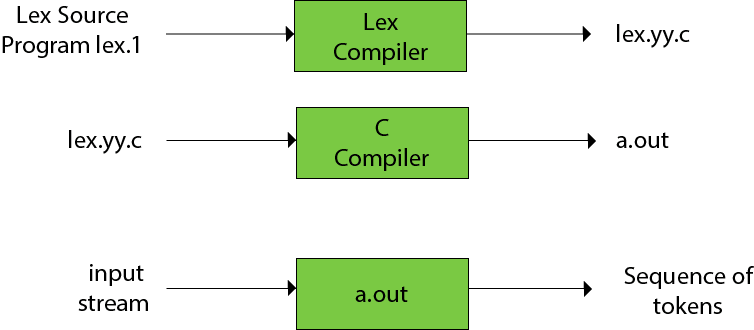
The function of Lex is as follows:
- Firstly lexical analyzer creates a program lex.1 in the Lex language. Then Lex compiler runs the lex.1 program and produces a C program lex.yy.c.
- Finally C compiler runs the lex.yy.c program and produces an object program a.out.
- a.out is lexical analyzer that transforms an input stream into a sequence of tokens.
Lex file format
A Lex program is separated into three sections by %% delimiters. The formal of Lex source is as follows:
{ definitions }
%%
{ rules }
%%
{ user subroutines }
Definitions include declarations of constant, variable and regular definitions.
Rules define the statement of form p1 {action1} p2 {action2}....pn {action}.
Where pi describes the regular expression and action1 describes the actions what action the lexical analyzer should take when pattern pi matches a lexeme.
User subroutines are auxiliary procedures needed by the actions. The subroutine can be loaded with the lexical analyzer and compiled separately.
Labels: CD Unit-1, Compiler Design
Discussion & Queries (<$I18NNumComments$>):
<$CommentPager$>
- <$I18NAtCommentTimeWithPermalink$>, <$I18NCommentAuthorSaid$>
<$CommentPager$>
<$BlogCommentBody$>
<$BlogCommentDeleteIcon$>