Oblique Projection
In oblique projection, the direction of projection is not normal to the projection of plane. In oblique projection, we can view the object better than orthographic projection.
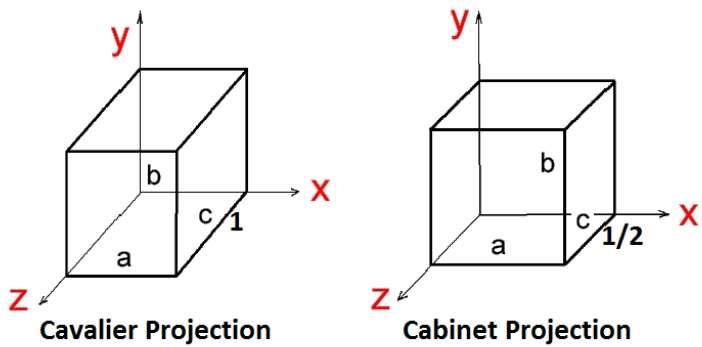
There are two types of oblique projections − Cavalier and Cabinet. The Cavalier projection makes 45° angle with the projection plane. The projection of a line perpendicular to the view plane has the same length as the line itself in Cavalier projection. In a cavalier projection, the foreshortening factors for all three principal directions are equal.
The Cabinet projection makes 63.4° angle with the projection plane. In Cabinet projection, lines perpendicular to the viewing surface are projected at ½ their actual length. Both the projections are shown in the following figure −
Derivation:-
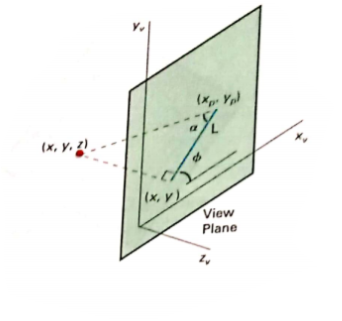
- We can express the projection coordinates in terms of x,y,l,θ as
Xp = x + LCosθ
yp = y + LSinθ
- Length L depends on the angle α and the zcoordinate of point to be projected.
tan α = Z/L => L = Z/tan α = ZL1
when Z – 1, L = L1
- Now we can write oblique projection as
Xp = x + Z(L1Cosθ)
yp = y + Z(L1Sinθ)
- Considering Zp = 0, we get

Discussion & Queries (<$I18NNumComments$>):
<$CommentPager$>
- <$I18NAtCommentTimeWithPermalink$>, <$I18NCommentAuthorSaid$>
<$CommentPager$>
<$BlogCommentBody$>
<$BlogCommentDeleteIcon$>