Saturday, November 20, 2021

The pigeonhole Principle

If n pigeonholes are occupied by n+1 or more pigeons, then at least one pigeonhole is occupied by greater than one pigeon. Generalized pigeonhole principle is: - If n pigeonholes are occupied by kn+1 or more pigeons, where k is a positive integer, then at least one pigeonhole is occupied by k+1 or more pigeons.

Example1: Find the minimum number of students in a class to be sure that three of them are born in the same month.

Solution: Here n = 12 months are the Pigeonholes
                    And k + 1 = 3
                    K = 2

Example2: Show that at least two people must have their birthday in the same month if 13 people are assembled in a room.

Solution: We assigned each person the month of the year on which he was born. Since there are 12 months in a year.

So, according to the pigeonhole principle, there must be at least two people assigned to the same month.

Inclusion-Exclusion Principle:

Let A1,A2......Ar be the subset of Universal set U. Then the number m of the element which do not appear in any subset A1,A2......Ar of U.

Pigeonhole Principle

Example: Let U be the set of positive integer not exceeding 1000. Then |U|= 1000 Find |S| where S is the set of such integer which is not divisible by 3, 5 or 7?

Solution: Let A be the subset of integer which is divisible by 3
                Let B be the subset of integer which is divisible by 5
                Let C be the subset of integer which is divisible by 7

Then S = Ac ∩ Bc∩ Cc since each element of S is not divisible by 3, 5, or 7.

By Integer division,

          |A|= 1000/3 = 333
          |B|= 1000/5 = 200
          |C| = 1000/7 = 142
          |A∩B|=1000/15=66
          |B∩C|=1000/21=47
          |C∩A|=1000/35=28
          |A∩B∩C|=1000/105=9

Thus by Inclusion-Exclusion Principle

          |S|=1000-(333+200+142)+(66+47+28)-9
          |S|=1000-675+141-9=457

Labels: ,

Permutation and Combination

Permutation:

Any arrangement of a set of n objects in a given order is called Permutation of Object. Any arrangement of any r ≤ n of these objects in a given order is called an r-permutation or a permutation of n object taken r at a time.

It is denoted by P (n, r)
                          P (n, r) =Permutation and Combinations

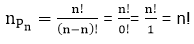
Theorem: Prove that the number of permutations of n things taken all at a time is n!.

Proof: We know that

Permutation and Combinations

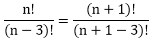
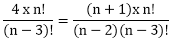
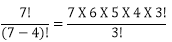
Example: 4 x np3=n+1P3

Solution: 4 x Permutation and Combinations

                Permutation and Combinations
                4 (n-2) = (n+1)
                 4n - 8 = n+1
                      3n = 9
                        n = 3.

Permutation with Restrictions:

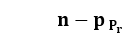
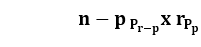
The number of permutations of n different objects taken r at a time in which p particular objects do not occur is

Permutation and Combinations

The number of permutations of n different objects taken r at a time in which p particular objects are present is

Permutation and Combinations

Example: How many 6-digit numbers can be formed by using the digits 0, 1, 2, 3, 4, 5, 6, 7, 8 if every number is to start with '30' with no digit repeated?

Solution: All the numbers begin with '30.'So, we have to choose 4-digits from the remaining 7-digits.

            ∴ Total number of numbers that begins with '30' is
7P4 = Permutation and Combinations=840.

Permutations with Repeated Objects:

Theorem: Prove that the number of different permutations of n distinct objects taken at a time when every object is allowed to repeat any number of times is given by nr.

Proof: Assume that with n objects we have to fill r place when repetition of the object is allowed.

Therefore, the number of ways of filling the first place is = n
                 The number of ways of filling the second place = n
                 .............................
                 .............................
                 The number of ways of filling the rth place = n
Thus, the total number of ways of filling r places with n elements is
                  = n. n. n..............r times =nr.

Circular Permutations:

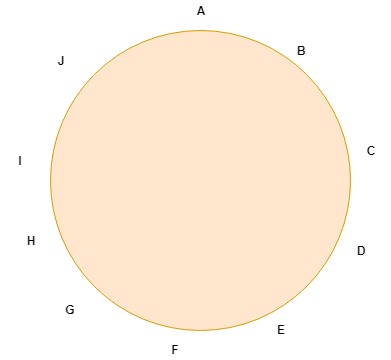
A permutation which is done around a circle is called Circular Permutation.

Permutation and Combinations

Example: In how many ways can get these letters a, b, c, d, e, f, g, h, i, j arranged in a circle?

Solution: (10 - 1) = 9! = 362880

Theorem: Prove that the number of circular permutations of n different objects is (n-1)!

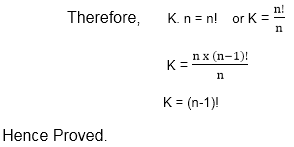
Proof: Let us consider that K be the number of permutations required.

For each such circular permutations of K, there are n corresponding linear permutations. As shown earlier, we start from every object of n object in the circular permutations. Thus, for K circular permutations, we have K...n linear permutations.

Permutation and Combinations

Combination:

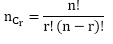
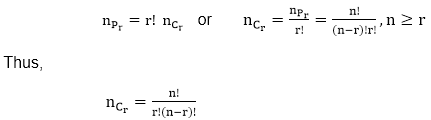
A Combination is a selection of some or all, objects from a set of given objects, where the order of the objects does not matter. The number of combinations of n objects, taken r at a time represented by nCr or C (n, r).

Permutation and Combinations

Proof: The number of permutations of n different things, taken r at a time is given by

Permutation and Combinations

As there is no matter about the order of arrangement of the objects, therefore, to every combination of r things, there are r! arrangements i.e.,

Permutation and Combinations

Example: A farmer purchased 3 cows, 2 pigs, and 4 hens from a man who has 6 cows, 5 pigs, and 8 hens. Find the number m of choices that the farmer has.

The farmer can choose the cows in C (6, 3) ways, the pigs in C (5, 2) ways, and the hens in C (8, 4) ways. Thus the number m of choices follows:

Permutation and Combinations

Labels: ,

Basic Counting Techniques

Sum Rule Principle: Assume some event E can occur in m ways and a second event F can occur in n ways, and suppose both events cannot occur simultaneously. Then E or F can occur in m + n ways.

In general, if there are n events and no two events occurs in same time then the event can occur in n1+n2..........n ways.

Example: If 8 male processor and 5 female processor teaching DMS then the student can choose professor in 8+5=13 ways.

Product Rule Principle: Suppose there is an event E which can occur in m ways and, independent of this event, there is a second event F which can occur in n ways. Then combinations of E and F can occur in mn ways.

In general, if there are n events occurring independently then all events can occur in the order indicated as n1 x n2 x n3.........n ways.

Example: In class, there are 4 boys and 10 girls if a boy and a girl have to be chosen for the class monitor, the students can choose class monitor in 4 x 10 = 40 ways.

Mathematical Functions:

Factorial Function: The product of the first n natural number is called factorial n. It is denoted by n!, read "n Factorial."

The Factorial n can also be written as

  1. n! = n (n-1) (n-2) (n-3)......1.  
  2.  = 1   and    0! = 1.  

Example1: Find the value of 5!

Solution:

5! = 5 x (5-1) (5-2) (5-3) (5-4)
   = 5 x 4 x 3 x 2 x 1 = 120

Example2: Find the value of Counting Principles

Solution: Counting Principles =Counting Principles= 10 x 9=90

Binomial Coefficients: Binomial Coefficient is represented by nCr where r and n are positive integer with r ≤ n is defined as follows:

Counting Principles

Example: 8C2 =Counting Principles=Counting Principles= 28.

Labels: ,

Combinatorics

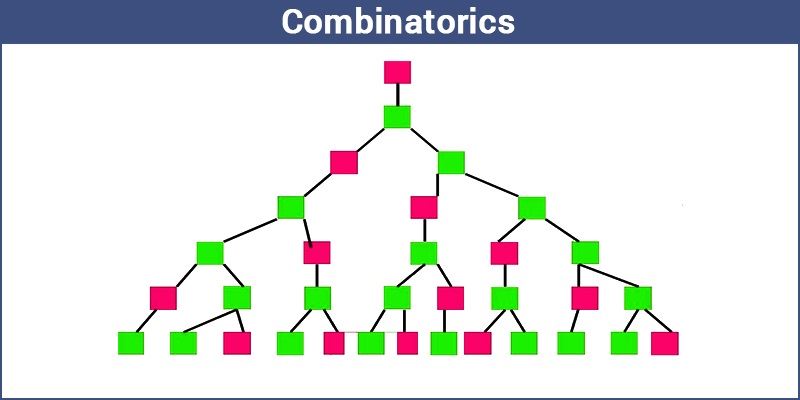
Combinatorics is a stream of mathematics that concerns the study of finite discrete structures. It deals with the study of permutation and combination, enumerations of the sets of elements. It characterizes Mathematical relations and their properties.

Mathematicians uses the term “Combinatorics” as it refers to the larger subset of Discrete Mathematics.  It is frequently used in computer Science to derive the formulas and it is used for the estimation of the analysis of the algorithms. In this article, let us discuss what is combinatorics, its features, formulas, applications and examples in detail.

Features of combinatorics

Combinatorics

Some of the important features of the combinatorics are as follows:

  • Counting the structures of the provided kind and size.
  • To decide when particular criteria can be fulfilled and analyzing elements of the criteria, such as combinatorial designs.
  • To identify “greatest”, “smallest” or “optimal” elements, known as external combinatorics.

Combinatorial structures that rise in an algebraic concept, or applying algebraic techniques to combinatorial problems, known as algebraic combinatorics.

What are permutation and Combination?

In English, we make use of the word “combination” without thinking if the order is important. Let’s take a simple instance.

The fruit salad is a combination of grapes, bananas, and apples. The order of fruits in the salad does not matter because it is the same fruit salad.

But, let us assume that, the combination of a key is 475. You need to take care of the order, since the other combinations like 457, 574, or others won’t work. Only the combination of 4 – 7 – 5 can unlock.

Hence, to be precise;

  • When the order does not have much impact, it is said to be a combination.
  • When the order does have an impact, it is said to be a permutation.

Labels: ,

Generating Functions

Generating function is a method to solve the recurrence relations.

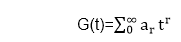
Let us consider, the sequence a0, a1, a2....ar of real numbers. For some interval of real numbers containing zero values at t is given, the function G(t) is defined by the series
            G(t)= a0, a1t+a2 t2+⋯+ar tr+............equation (i)

This function G(t) is called the generating function of the sequence ar.

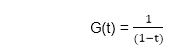
Now, for the constant sequence 1, 1, 1, 1.....the generating function is

Generating Functions

It can be expressed as

            G(t) =(1-t)-1=1+t+t2 +t3+t4+⋯[By binomial expansion]

Comparing, this with equation (i), we get

            a0=1,a1=1,a2=1 and so on.

For, the constant sequence 1,2,3,4,5,..the generating function is
            G(t) = Generating Functionsbecause it can be expressed as
            G(t) =(1-t)-2=1+2t+3t2 +4t3+⋯+(r+1) tr

Comparing, this with equation (i), we get
a0=1,a1=2,a2=3,a3=4 and so on.

The generating function of Zr,(Z≠0 and Z is a constant)is given by
            G(t)= 1+Zt+Z2 t2+Z3 t3+⋯+Zr tr
            G(t)=Generating Functions       [Assume |Zt|<1]
So,       G(t)=Generating Functions generates Zr,Z≠0

Also,If a(1)r has the generating function G1(t) and a(2)r has the generating function G2(t), then λ1 a(1)r+λ2 a(2)r has the generating function λ1 G1(t)+ λ2 G2(t). Here λ1 and λ2 are constants.

Application Areas:

Generating functions can be used for the following purposes -

  • For solving recurrence relations
  • For proving some of the combinatorial identities
  • For finding asymptotic formulae for terms of sequences

Example: Solve the recurrence relation ar+2-3ar+1+2ar=0

By the method of generating functions with the initial conditions a0=2 and a1=3.

Solution: Let us assume that

Generating Functions

Multiply equation (i) by tr and summing from r = 0 to ∞, we have

Generating Functions

(a2+a3 t+a4 t2+⋯)-3(a1+a2 t+a3 t2+⋯)+2(a0+a1 t+a2 t2+⋯)=0
     [∴ G(t)=a0+a1 t+a2 t2+⋯]

Generating Functions +2G(t)=0............equation (ii)

Now, put a0=2 and a1=3 in equation (ii) and solving, we get

Generating Functions

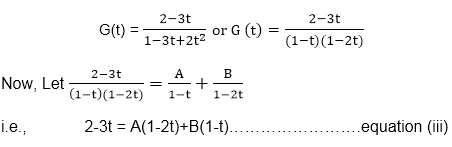
Put t=1 on both sides of equation (iii) to find A. Hence
            -1=- A       ∴ A = 1

Put t=Generating Functions on both sides of equation (iii) to find B. Hence
            Generating Functions=Generating Functions B       ∴ B = 1

Thus G (t) = Generating Functions.Hence,ar=1+2r.

Labels: ,

Total Solution

The total solution or the general solution of a non-homogeneous linear difference equation with constant coefficients is the sum of the homogeneous solution and a particular solution. If no initial conditions are given, obtain n linear equations in n unknowns and solve them, if possible to get total solutions.

If y(h) denotes the homogeneous solution of the recurrence relation and y(p) indicates the particular solution of the recurrence relation then, the total solution or the general solution y of the recurrence relation is given by
                  y =y(h)+y(p).

Example: Solve the difference equation
                 ar-4ar-1+4ar-2=3r+2r...........equation (i)

Solution: The homogeneous solution of this equation is obtained by putting R.H.S equal to zero i.e.,
                 ar-4ar-1+4ar-2=0

The homogeneous solution is ar(h)= (C1+C2 r).2r

The equation (i) can be written as (E2-4E+4) ar=3r+2r

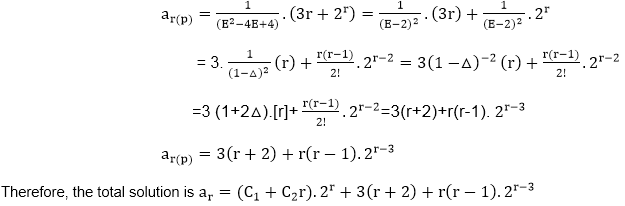
The particular solution is given as

Total Solution

Labels: ,

Particular Solution

(a) Homogeneous Linear Difference Equations and Particular Solution:

We can find the particular solution of the difference equation when the equation is of homogeneous linear type by putting the values of the initial conditions in the homogeneous solutions.


Example1: Solve the difference equation 2ar-5ar-1+2ar-2=0 and find particular solutions such that a0=0 and a1=1.

Solution: The characteristics equation is 2s2-5s+2=0
(2s-1)(s-2)=0
s = Particular Solution and 2.

Therefore, the homogeneous solution of the equation is given by

ar(h)= C1Particular Solution+C2 .2r..........equation (i)

Putting r=0 and r=1 in equation (i), we get
      a0=C1+C2=0...........equation (a)
      a1=Particular Solution C1+2C2=1...........equation.(b)

Solving eq (a) and (b), we have
C1=-Particular Solutionand C2=Particular Solution

Hence, the particular solution is
Particular Solution


Example2: Solve the difference equation ar-4ar-1+4ar-2=0 and find particular solutions such that a0=0 and a1=6.

Solution: The characteristics equation is
            s2-4s+4=0 or (s-2)2=0             s = 2, 2

Therefore, the homogeneous solution of the equation is given by
            ar(n)=(C1+C2 r).2r.............. equation (i)

Putting r = 0 and r = 1 in equation (i), we get
            a0=(C1+0).20 = 1          ∴C1=1
            a1=(C1+C2).2=6          ∴C1+C2=3⇒C2=2

Hence, the particular solution is
            ar(P)=(1+2r).2r.


Example3: Solve the difference equation 9ar-6ar-1+ar-2=0 satisfying the conditions a0=0 and a1=2.

Solution: The characteristics equation is

            9s2-6s+1=0 or (3s-1)2=0
            s = Particular Solution

Therefore, the homogeneous solution of the equation is given by
            ar(h)=(C1+C2 r).Particular Solution ..........equation (i)

Putting r = 0 and r = 1 in equation (i), we get
            a0=C_1=0
            a1= (C1+C2).Particular Solution=2.           ∴C1+C2=6⇒C2=6

Hence, the particular solution is
            ar(P)=6r.Particular Solution.


(b) Non-Homogeneous Linear Difference Equations and Particular Solution:

There are two methods to find the particular solution of a non-homogeneous linear difference equation. These are as follows:

  1. Undetermined coefficients method
  2. E and ∆ operator method.

1. Undetermined Coefficients Method: This method is used to find a particular solution of non-homogeneous linear difference equations, whose R.H.S term R (n) consist of terms of special forms.

In this method, firstly we assume the general form of the particular solutions according to the type of R (n) containing some unknown constant coefficients, which have to be determined. Then according to the difference equation, we will determine the exact solution.

The general form of a particular solution to be assumed for the special forms of R (n), to find the exact solution is shown in the table.

Form of R (n)General form to be assumed
Z, here z is constantA
Zr, here z is constantZr
P (r), a polynomial of degree nA0 rn+A1 rn-1+⋯..An
Zr. P (r), here P(r) is a polynomial of the nth degree in r. Z is a constant.[A0 rn+A1 rn-1+⋯..An].Zr

Example1: Find the particular solution of the difference equation ar+2-3ar+1+2ar=Zr ........equation (i)

Where Z is some constant.

Solution: The general form of solution is = A. Zr

Now putting this solution on L.H.S of equation (i), we get
            = A Zr+2-3AZr+1+2AZr=(Z2-3Z+2) A Zr.........equation (ii)

Equating equation (ii) with R.H.S of equation (i), we get
            (Z2-3Z+2)A=1
            A =Particular Solution(Z≠1, Z≠2)
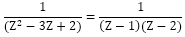
Therefore, the particular solution isParticular Solution


Example2: Find the particular solution of the difference equation ar+2-5ar+1+6ar=5r .............equation (i)

Solution: Let us assume the general form of the solution= A. 5r.

Now to find the value of A, put this solution on L.H.S of the equation (i), then this becomes
            = A. 5r+2-5.A5r+1+6.A5r
            = 25A. 5r-25A.5r+6A.5r
            = 6A.5r ............equation (ii)

Equating equation (ii) to R.H.S of equation (i), we get
            A =Particular Solution

Therefore, the particular solution of the difference equation is =Particular Solution.5r.


Example3: Find the particular solution of the difference equation ar+ 2+ar+1+ar=r.2r..........equation (i)

Solution: Let us assume the general form of the solution = (A0+A1r). 2^r

Now, put these solutions in the L.H.S of the equation (i), we get
            = 2r+2 [A0+A1 (r+2)]+2r+1 [A0+A1 (r+1)]+2r (A0+A1 r)
            = 4. 2r (A0+A1 r+2A1 )+2.2r (A0+A1 r+A1 )+2r (A0+A1 r)
            = r. 2r (7A1 )+2r (7A0+10A1)............equation (ii)

Equating equation (ii) with R.H.S of equation (i), we get
            7A1=1             ∴ A1=Particular Solution
            7A0+10A1=0         ∴ A0=Particular Solution

Therefore, the particular solution is Particular Solution


2. E and ∆ operator Method:

Definition of Operator E: The operator of E on f(x) means that give an increment to the value of x in the function. The operation of E is, put (x+h) in the function wherever there is x. Here h is increment quantity. So Ef(x) = f(x+h)

Here, E is operated on f(x), therefore, E is a symbol known as shift operator.

Definition of Operator∆: The operation ∆ is an operation of two steps.

Firstly, x in the function is incremented by a constant and then former is subtracted from the later i.e.,
            ∆f(x)=f(x+h)-f(x)

Theorem1: Prove that E ≅1+∆.

Proof: The operation of ∆ on f(x) is of two steps. First, increment the value of x in the function. So, whenever, there is x in f(x) put x+h (here h is constant increment), which means operation of E on f(x) i.e.,
            f (x+h)=Ef(x).

Second, subtract the original function from the value obtained in the first step, hence
            ∆f(x)=Ef(x)-1f(x)=(E-1)f(x)

So, the operation of ∆ on f(x) is equivalent to the operation of (E-1) on f(x).

Therefore, we have
            E ≅1+∆.

Theorem2: Show that En f(x)=f(x+nh).

Proof: We know that E f(x) =f (x+h)

Now       En f(x)=E.E.E.E.........n times f(x)
        = En-1 [E f(x)] = En-1 f(x+h)
        = En-2 [E f(x+h)] = En-2 f(x+2h)
        ......................
        ......................
      = E f[x+ (n-1) h] = f(x+nh).

Theorem3: Show that E Cf(x) = CE f(x)

Proof: We know that E C f(x) = C f(x+h) = CE f(x+h). Hence Proved.

There is no effect of the operation of E on any constant. Therefore, the operation of E on any constant will be equal to constant itself.

By E and ∆ operator method, we will find the solution of
            C0 yn+r+C1 yn+r-1+C2 yn+r-2+⋯+Cn yn=R (n)..............equation (i)

Equation (i) can be written as
        C0 Er yn+C1 Er-1 yn+C2 Er-2 yn+⋯+Cn yn=R (n)
        (C0 Er+C1 Er-1+C2 Er-2+⋯+Cn) yn=R (n)
Putting C0 Er+C1 Er-1+C2 Er-2+⋯+Cn=P(E)

So     P (E) yn=R (n)
        ∴     yn=Particular Solution................equation (ii)

To find the particular solution of (ii) for different forms of R (n), we have the following cases.

Case1: When R (n) is some constant A.

We know that, the operation of E on any constant will be equal to the constant itself i.e.,
            EA=A
Therefore,     P (E) A = (C0 Er+C1 Er-1+C2 Er-2+⋯+Cn)A
            = (C0+C1+C2+⋯+Cn)A
            = P (1) A
            Particular Solution
Therefore, using equation (ii), the particular solution of (i) is
            yn=Particular Solution,P(1)≠0

P (1) is obtained by putting E = 1 in P (E).

Case2: When R (n) is of the form A. Zn, where A and Z are constants

We have,     P (E) (A. Zn)={C0 Er+C1 Er-1+⋯+ Cn} (A.Zn)
                                          =A{C0 Zr+n+C1 Zr+n-1+⋯+Cn Zn}
                                          = A{C0 Zr+C1 Zr-1+⋯+Cn }. Zn
                                          =AP(Z).Zn

To get, P (Z) put E=Z in P (E)

Therefore, Particular Solution, provided P (Z) ≠ 0

Thus,       yn=Particular Solution, P (Z) ≠ 0

If A = 1, then    yn=Particular Solution

When P (Z) = 0 then for equation

          (i) (E-Z) yn= A. Zn

For this, the particular solution becomes A. Particular Solution Zn=A. n Zn-1

          (ii) (E-Z)2 yn= A. Zn

For this, the particular solution becomes Particular Solution

          (iii) (E-Z)3 yn= A. Zn

For this, the particular solution becomesParticular Solution and so on.

Case3: When R (n) be a polynomial of degree m is n.

We know that E≅1+∆
So,       P (E) =P (1+∆)

Particular Solution

Which can be expanded in ascending power of ∆ as far as upto ∆m

⇒       Particular Solution =(b0+b1 ∆+b2 ∆+⋯.+bm ∆m+⋯)
⇒ Particular Solution.R(n)=( b0+b1 ∆+b2 ∆+⋯.+bm ∆m+⋯).R(n)
            = b0 R(n)+b1 ∆ R(n)+⋯+bm ∆m R(n)

All other higher terms will be zero because R (n) is a polynomial of degree m.

Thus, the particular solution of equation (i), in this case will be

            yn=b0 R(n)+b1 ∆ R(n)+⋯.+bm ∆m R(n).

Case4: When R (n) is of the form R(n).Zn,where R(n) is a polynomial of degree m and Z is some constant

We have         Er[Zn R(n)]=Zr+n R (n+r)=Zr.Zn.Er.R(n)=Zn (ZE)rR(n)

Similarly, we have
Particular Solution [Zn R(n)]=Zn Particular Solution .(R(n))= Zn [P(Z+Z∆)]-1.R(n)

Thus, the particular solution of equation (i), in this case will be
            yn=Zn [P(Z+Z∆)]-1.R(n)

Example1: Find the particular solution of the difference equation
            2ar+1-ar=12.

Solution: The above equation can be written as
            (2E-1) ar=12

The particular solution is given by
            ar=Particular Solution.12

Put E=1, in the equation. The particular solution is ar=12

Example2: Find the particular solution of the difference equation ar-4ar-1+4ar-2=2r.

Solution: The above equation can be written as
           (E2-4E+4) ar=2r

Therefore,       P (E) = E2-4E+4 = (E-2)2

Thus, the particular solution is given by
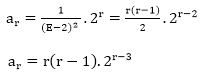
Particular Solution

Labels: ,