Tuesday, November 30, 2021

Longest Common Sequence

Algorithm of Longest Common Sequence

LCS-LENGTH (X, Y)
 1. m ← length [X]										
 2. n ← length [Y]
 3. for i ← 1 to m
 4. do c [i,0] ← 0
 5. for j ← 0 to m
 6. do c [0,j] ← 0
 7. for i ← 1 to m
 8. do for j ← 1 to n
 9. do if xi= yj	
 10. then c [i,j] ← c [i-1,j-1] + 1	
 11. b [i,j] ← "↖"
 12. else if c[i-1,j] ≥ c[i,j-1]
 13. then c [i,j] ← c [i-1,j]
 14. b [i,j] ← "↑"
 15. else c [i,j] ← c [i,j-1]
 16. b [i,j] ← "← "
 17. return c and b.

Example of Longest Common Sequence

Example: Given two sequences X [1...m] and Y [1.....n]. Find the longest common subsequences to both.

Example of Longest Common Sequence

here X = (A,B,C,B,D,A,B) and Y = (B,D,C,A,B,A)
     m = length [X] and n = length [Y]
     m = 7 and n = 6
Here x1= x [1] = A   y1= y [1] = B
     x2= B  y2= D
     x3= C  y3= C
     x4= B  y4= A
     x5= D  y5= B
     x6= A  y6= A
     x7= B
Now fill the values of c [i, j] in m x n table
Initially, for i=1 to 7 c [i, 0] = 0
          For j = 0 to 6 c [0, j] = 0

That is:
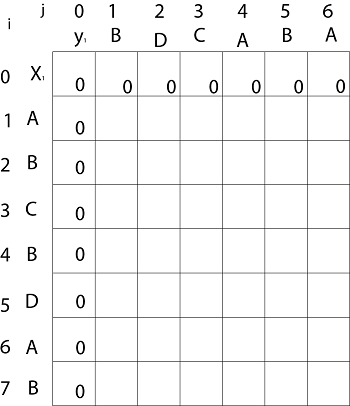
DAA Example of Longest Common Sequence

Now for i=1 and j = 1
x1 and y1 we get x1 ≠ y1 i.e. A ≠ B
And c [i-1,j] = c [0, 1] = 0
c [i, j-1] = c [1,0 ] = 0
That is, c [i-1,j]= c [i, j-1] so c [1, 1] = 0 and b [1, 1] = ' ↑  '

Now for i=1 and j = 2
x1 and y2 we get x1 ≠ y2 i.e. A ≠ D
c [i-1,j] = c [0, 2] = 0
c [i, j-1] = c [1,1 ] = 0
That is, c [i-1,j]= c [i, j-1] and c [1, 2] = 0 b [1, 2] = '  ↑  '

Now for i=1 and j = 3
x1 and y3 we get x1 ≠ y3 i.e. A ≠ C
c [i-1,j] = c [0, 3] = 0
c [i, j-1] = c [1,2 ] = 0
so c [1,3] = 0     b [1,3] = ' ↑ '

Now for i=1 and j = 4
x1 and y4 we get. x1=y4 i.e A = A 
c [1,4] = c [1-1,4-1] + 1
   = c [0, 3] + 1
     = 0 + 1 = 1
c [1,4] = 1
b [1,4] = '  ↖  '

Now for i=1 and j = 5
           x1 and y5  we get x1 ≠ y5
           c [i-1,j] = c [0, 5] = 0
c [i, j-1] = c [1,4 ] = 1
Thus c [i, j-1] >  c [i-1,j] i.e. c [1, 5] = c [i, j-1] = 1. So b [1, 5] = '←'

Now for i=1 and j = 6
           x1 and y6   we get x1=y6
                     c [1, 6] = c [1-1,6-1] + 1
                              = c [0, 5] + 1 = 0 + 1 = 1
   c [1,6] = 1
   b [1,6] = '  ↖  '
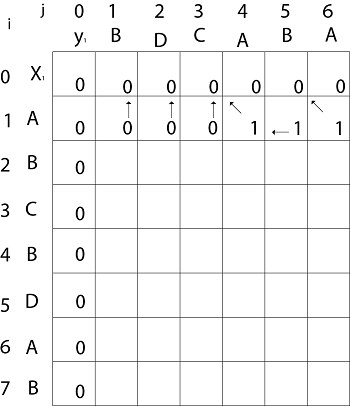
Example of Longest Common Sequence

Now for i=2 and j = 1
 We get x2 and y1 B = B i.e.  x2= y1
             c [2,1] = c [2-1,1-1] + 1
                     = c [1, 0] + 1
                     = 0 + 1 = 1   
             c [2, 1] = 1 and b [2, 1] = ' ↖ '
Similarly, we fill the all values of c [i, j] and we get

Example of Longest Common Sequence

Step 4: Constructing an LCS: The initial call is PRINT-LCS (b, X, X.length, Y.length)

PRINT-LCS (b, x, i, j)
 1. if i=0 or j=0
 2. then return
 3. if b [i,j] = ' ↖ '
 4. then PRINT-LCS (b,x,i-1,j-1)
 5. print x_i
 6. else if b [i,j] = '  ↑  '
 7. then PRINT-LCS (b,X,i-1,j)
 8. else PRINT-LCS (b,X,i,j-1)

Example: Determine the LCS of (1,0,0,1,0,1,0,1) and (0,1,0,1,1,0,1,1,0).

Solution: let X = (1,0,0,1,0,1,0,1) and Y = (0,1,0,1,1,0,1,1,0).

Example of Longest Common Sequence

We are looking for c [8, 9]. The following table is built.

Example of Longest Common Sequence

From the table we can deduct that LCS = 6. There are several such sequences, for instance (1,0,0,1,1,0) (0,1,0,1,0,1) and (0,0,1,1,0,1)

Labels: ,

Wednesday, November 24, 2021

MANAGERIAL APPRAISAL

MANAGERIAL APPRAISAL

Harold Koontz has developed a concept of managerial appraisal i.e., appraising managers. According to this concept the managers attain the organizational objectives by performing the basic managerial functions, viz., planning, organizing, leading, motivating, staffing and controlling. Each of these functions can be performed by performing a number of or series of activities.


For example, performing staffing function requires performing a series of activities like analyzing jobs of his department, planning for human resources, deciding upon internal and external recruitment, developing sources and recruitment techniques. Thus, each function and sub-function of manager is elaborated into a series of activities. These activities, in this model are taken as behavior and standards of performance. The checklist containing the questions in these areas is prepared with a five degree rating scale, i.e., extremely poor performance, neither poor nor fair performance and extremely fair performance.


The appraisers rate performance of managers by assessing weights to the scale and appraise only those areas which are clear and are supported by adequate knowledge. Thus, this technique measures the performance of managers in managing organizational environment.


Labels:

What is Market Appraisal?

What is Market Appraisal?

A market appraisal is a form of an assessment or an evaluation that is done by some authorized financial institution or an agent who deals with the estate. They can recommend the various ways in which the products that are being manufactured or which are being sold, its value is realized in the best possible way and is also priced at its best in a given timescale.


The market appraisal thus refers to that formal assessment. In general, a market appraisal is something that one gets when one the owner of a property would ask their agent about what is the total worth of their property.

Thus the market appraisal is a kind of advice given by the agent to the owner of any particular property. This advice that is provided by the estate is generally in quite a proximity to the actual value of that property in the market. Also, the pricing may vary depending upon the direction in which the market is moving.


Thus it can make a huge difference. Now if a market is found to moving in the upward direction, then it is more like that the values of the appraisal will be lifted higher. And here the result that is obtained, chances are that it will be greatly influenced by the desire of the owner to sell their property and to list it with the agent he was in talks with at the first place.


Thus for an appraisal to be relatively high is not that common in the market. This appraisal will not be a proper valuation, so one can’t sue it with any particular lender such that the market value of the property can be well established.


Now people often tend to confuse between the valuation and the appraisal. Let us see how the two terms are different from each other. Now in the case of the appraisal, any real agent can give that to you, but when it comes to the ‘valuation,’ in such a case, an accredited value which usually occurs on the panel of the lender is allowed to give a valuation.

In the case of the valuation, only a relied upon lender can provide you with valuation when you will be applying for a loan.  Now one thing to note is that here the panel to which the value belongs to consist of all the approved valuers for that individual who is lending the loan.


Factors in Market Appraisal

Now since that the market appraisal should be carefully taken into account as it would play a significant role in pricing your estate in the market, here are a few factors that you must take into consideration before going for market appraisal.


1.    The first thing that should be taken into consideration is that whether there are fundamental sales forces as well as the distribution network in the unit itself so that the products that are manufactured can be sold out.

2.    The second factor that should be taken into consideration is how the unit can capture the shares of the available market.

3.    The next thing is that if the desired price point is set for every individual product, then will the units be able to sell those products.

4.    Another factor that should be considered is that to analyze the market of whether it is a sizable potential market or not and what are the various marketing strategies that would be the most suitable and that are set by the unit itself.

5.    The next factors that should be taken into consideration are whether the products that are to be marketed, be delivered by the units from those sources from where it is deployed.

6.    And the last factors that should be taken into consideration are that after selling, the value of the return on investments obtained, will it be able to cover up for the cost of the loan or the equity. And on top of it after covering up for the loans, will it still be able to a fair amount of share so that the further sustainable operations will be carried out.


Labels:

Environmental Appraisal

Environmental Appraisal is the process of identifying opportunities and threats facing an organization. Concept of EnvironmentEnvironment. literally means the surroundings, external objects, influences or circumstances under which someone or something exists.

what are the factors affecting environmental appraisal? Strategist related factors – Since strategist play a central role in formulation of strategies ,there characteristics such as age, education, experience, motivation, cognitive styles ,ability to withstand time pressure and responsibility have an impact to the extent to which they are able to appraise the environment.

Project appraisal is the process of assessing, in a structured way, the case for proceeding with a project or proposal, or the project's viability. It often involves comparing various options, using economic appraisal or some other decision analysis technique.


Why environmental analysis and appraisal is important?

An environmental analysis in plays an essential role in business management by providing possible opportunities or threats outside the company in its external environment. The purpose of an environmental analysis is to help to develop a plan by keeping decision-makers within an organization.


Labels:

What Is a Feasibility Study?

A feasibility study is simply an assessment of the practicality of a proposed project plan or method. This is done by analyzing technical, economic, legal, operational and time feasibility factors. Just as the name implies, you’re asking, “Is this feasible?” For example, do you have or can you create the technology to do what you propose? Do you have the people, tools and the resources necessary? And, will the project get you the ROI you expect?

When should project managers do a feasibility study? It should be done during that point in the project management life cycle after the business case has been completed.

So, that’s the “what” and the “when” but how about the “why?” Meaning, why do you need a feasibility study? Well, it determines the factors that affect project feasibility, making it pretty important.


What Is Included in a Feasibility Study Report?

The findings of your project feasibility study are compiled in a feasibility report that usually includes the following elements.

1.    Executive summary

2.    Description of product/service

3.    Technology considerations

4.    Product/service marketplace

5.    Marketing strategy

6.    Organization/staffing

7.    Schedule

8.    Financial projections

9.    Findings and recommendations


Types of Feasibility Study

·         Technical Feasibility: Consists in determining if your organization has the technical resources and expertise to meet the project requirements.

·         Economic Feasibility: You’ll need to do an assessment of the economic factors of your project to determine its financial viability. You can use a cost-benefit analysis to compare its financial costs against its projected benefits.

·         Legal Feasibility: Your project must meet legal requirements. That includes laws and regulations that apply to all activities and deliverables in your project scope.

·         Operational Feasibility: Operational feasibility refers to how well your project matches your organization’s capacity planning, resources, strategic goals and business objectives.

·         Time Feasibility: Estimate the time that will take to execute the project and set deadlines. Then think how your project timeline fits with your current operations, such as your demand planning, production schedule, among many other things.


7 Steps To Do a Feasibility Study

1. Conduct a Preliminary Analysis

Begin by outlining your project plan. You should focus on an unserved need, a market where the demand is greater than the supply, and whether the product or service has a distinct advantage. Then you need to determine if the feasibility factors are too high to clear (i.e. too expensive, unable to effectively market, etc.).

2. Prepare a Projected Income Statement

This step requires you to work backward. Start with what you expect the income from the project to be and then what project funding is needed to achieve that goal. This is the foundation of an income statement. Things to take into account here include what services are required and how much they’ll cost, any adjustments to revenues, such as reimbursements, etc.

3. Conduct a Market Survey, or Perform Market Research

This step is key to the success of your feasibility study, so make your market analysis as thorough as possible. It’s so important that if your organization doesn’t have the resources to do a proper one, then it is advantageous to hire an outside firm to do so.

The market research is going to give you the clearest picture of the revenues and return on investment you can realistically expect from the project. Some things to consider are the geographic influence on the market, demographics, analyzing competitors, the value of the market and what your share will be and if the market is open to expansion (that is, response to your offer).

4. Plan Business Organization and Operations

Once the groundwork of the previous steps has been laid, it’s time to set up the organization and operations of the planned project to meet its technical, operational, economic and legal feasibility factors. This is not a superficial, broad-stroke endeavor. It should be thorough and include start-up costs, fixed investments and operating costs.

These costs address things such as equipment, merchandising methods, real estate, personnel, supply availability, overhead, etc.

5. Prepare an Opening Day Balance Sheet

This includes an estimate of the assets and liabilities, one that should be as accurate as possible. To do this, create a list that includes items, sources, costs and available financing. Liabilities to consider are such things as leasing or purchasing of land, buildings and equipment, financing for assets and accounts receivables.

6. Review and Analyze All Data

All these steps are important, but the review and analysis are especially important to make sure that everything is as it should be and nothing requires changing or tweaking. So, take a moment to look over your work one last time.

Reexamine your previous steps, such as the income statement, and compare it with your expenses and liabilities. Is it still realistic? This is also the time to think about risk, analyzing and managing, and come up with any contingency plans.

7. Make a Go/No-Go Decision

You’re now at the point to make a decision about whether the project is feasible or not. That sounds simple, but all the previous steps lead to this decision-making moment. A couple of other things to consider before making that binary choice is whether the commitment is worth the time, effort and money and is it aligned with the organization’s strategic goals and long-term aspirations.


Labels:

The Project Life Cycle (Phases)

The project manager and project team have one shared goal: to carry out the work of the project for the purpose of meeting the project’s objectives. Every project has a beginning, a middle period during which activities move the project toward completion, and an ending (either successful or unsuccessful). A standard project typically has the following four major phases (each with its own agenda of tasks and issues): initiation, planning, implementation, and closure. Taken together, these phases represent the path a project takes from the beginning to its end and are generally referred to as the project “life cycle.”


Initiation Phase

During the first of these phases, the initiation phase, the project objective or need is identified; this can be a business problem or opportunity. An appropriate response to the need is documented in a business case with recommended solution options. A feasibility study is conducted to investigate whether each option addresses the project objective and a final recommended solution is determined. Issues of feasibility (“can we do the project?”) and justification (“should we do the project?”) are addressed.

Once the recommended solution is approved, a project is initiated to deliver the approved solution and a project manager is appointed. The major deliverables and the participating work groups are identified, and the project team begins to take shape. Approval is then sought by the project manager to move onto the detailed planning phase.


Planning Phase

The next phase, the planning phase, is where the project solution is further developed in as much detail as possible and the steps necessary to meet the project’s objective are planned. In this step, the team identifies all of the work to be done. The project’s tasks and resource requirements are identified, along with the strategy for producing them. This is also referred to as “scope management.” A project plan is created outlining the activities, tasks, dependencies, and timeframes. The project manager coordinates the preparation of a project budget by providing cost estimates for the labour, equipment, and materials costs. The budget is used to monitor and control cost expenditures during project implementation.

Once the project team has identified the work, prepared the schedule, and estimated the costs, the three fundamental components of the planning process are complete. This is an excellent time to identify and try to deal with anything that might pose a threat to the successful completion of the project. This is called risk management. In risk management, “high-threat” potential problems are identified along with the action that is to be taken on each high-threat potential problem, either to reduce the probability that the problem will occur or to reduce the impact on the project if it does occur. This is also a good time to identify all project stakeholders and establish a communication plan describing the information needed and the delivery method to be used to keep the stakeholders informed.

Finally, you will want to document a quality plan, providing quality targets, assurance, and control measures, along with an acceptance plan, listing the criteria to be met to gain customer acceptance. At this point, the project would have been planned in detail and is ready to be executed.


Implementation (Execution) Phase

During the third phase, the implementation phase, the project plan is put into motion and the work of the project is performed. It is important to maintain control and communicate as needed during implementation. Progress is continuously monitored and appropriate adjustments are made and recorded as variances from the original plan. In any project, a project manager spends most of the time in this step. During project implementation, people are carrying out the tasks, and progress information is being reported through regular team meetings. The project manager uses this information to maintain control over the direction of the project by comparing the progress reports with the project plan to measure the performance of the project activities and take corrective action as needed. The first course of action should always be to bring the project back on course (i.e., to return it to the original plan). If that cannot happen, the team should record variations from the original plan and record and publish modifications to the plan. Throughout this step, project sponsors and other key stakeholders should be kept informed of the project’s status according to the agreed-on frequency and format of communication. The plan should be updated and published on a regular basis.

Status reports should always emphasize the anticipated end point in terms of cost, schedule, and quality of deliverables. Each project deliverable produced should be reviewed for quality and measured against the acceptance criteria. Once all of the deliverables have been produced and the customer has accepted the final solution, the project is ready for closure.


Closing Phase

During the final closure, or completion phase, the emphasis is on releasing the final deliverables to the customer, handing over project documentation to the business, terminating supplier contracts, releasing project resources, and communicating the closure of the project to all stakeholders. The last remaining step is to conduct lessons-learned studies to examine what went well and what didn’t. Through this type of analysis, the wisdom of experience is transferred back to the project organization, which will help future project teams.


Labels:

Roles and Responsibilities of Project managers

Roles and Responsibilities of Project managers

1. Activity and resource planning

Planning is instrumental in meeting project deadlines, and many projects fail due to poor planning. First and foremost, good project managers define the project’s scope and determine available resources. Good project managers know how to realistically set time estimates and evaluate the team's or teams’ capabilities.

They then create a clear and concise plan to both execute the project and monitor its progress. Projects are naturally unpredictable, so good project managers know how to make adjustments along the way as needed before the project reaches its final stages.


2. Organizing and motivating a project team

Good project managers don’t get their teams bogged down with elaborate spreadsheets, long checklists, and whiteboards. Instead, they put their teams front and center. They develop clear, straightforward plans that stimulate their teams to reach their full potential. They cut down on bureaucracy and steer their teams down a clear path to the final goal.

"There is no other way than leading by example. If you are doing your part correctly, always supporting your team, and having a fair and healthy approach with them, motivation should never be a problem."


3. Controlling time management

Clients usually judge a project’s success or failure on whether it has been delivered on time. Therefore, meeting deadlines are non-negotiable. Good project managers know how to set realistic deadlines, and how to communicate them consistently to their teams.

They know how to effectively do the following:

Define activity

Sequence activity

Estimate the duration of activity

Develop a schedule

Maintain a schedule


4. Cost estimating and developing the budget

Good project managers know how to keep a project within its set budget. Even if a project meets a client’s expectations and is delivered on time, it will still be a failure if it goes wildly over budget. Good project managers frequently review the budget and plan ahead to avoid massive budget overruns.


5. Ensuring customer satisfaction

In the end, a project is only a success if the customer is happy. One of the key responsibilities of every project manager is to minimize uncertainty, avoid any unwanted surprises, and involve their clients in the project as much as is reasonably possible. Good project managers know how to maintain effective communication and keep the company’s clients up-to-date.


6. Analyzing and managing project risk

The bigger the project is, the more likely there are to be hurdles and pitfalls that weren’t part of the initial plan. Hiccups are inevitable, but good project managers know how meticulously and almost intuitively, identify and evaluate potential risks before the project begins. They know how to then avoid risks or at least minimize their impact.


7. Monitoring progress

During the initial stages, project managers and their teams have a clear vision and high hopes of producing the desired result. However, the path to the finish line is never without some bumps along the way. When things don’t go according to a plan, a project manager needs to monitor and analyze both expenditures and team performance and to always efficiently take corrective measures.


8. Managing reports and necessary documentation

Finally, experienced project managers know how essential final reports and proper documentation are. Good project managers can present comprehensive reports documenting that all project requirements were fulfilled, as well as the projects’ history, including what was done, who was involved, and what could be done better in the future.


Labels:

The Importance of Project Management:

1. Strategic Alignment: 

Mark Langley, the president and CEO of PMI, has said, “If your organization is not good at project management, you are putting too much at risk in terms of ultimately delivering on strategy.”

Strategic Alignment is the process of linking the organization’s structure and resources with its strategy and the ultimate objective. 

All the clients that approach you or give you a project, have certain objectives for their own organization and this project is a step in achieving that goal. Project Management is important here as it can align the tasks in such a way that the project connects with the strategic alignment of the customer too. 

A project manager ensures that the project helps in fulfilling the strategic alignment of the organization. 


2. Clear Focus and Objectives:

Project Management is important as it comes up with a proper project plan for achieving the strategic goals. 

If you leave the work of project management to your team you will see that there would be no accountability, the team would be working without proper brief, there would be a lack in focus, it could be possible that there are no clear objectives due to not having a proper project description, and the project can get stuck when any risk or problem arises.

Lack of clear goals was the most common reason for project failure in 2017.

A project manager can prevent such situations by breaking the project into tasks and helping/managing the team in completing the tasks on time and by project analysis.

The work is divided into small tasks and the completion of these tasks leads to the completion of the project. An efficient project manager foresees the risks, therefore risk management is an important part of project management.

If any risk or problem arises, an efficient project manager would be able to solve it without causing any delay in the project.


3. Leadership:

A project manager is like a leader whose goal is to complete the project within the time and budget and deliver what was promised or better. 

Doing a Project without Project Management is like sailing a ship of pirates without captain Jack Sparrow. Without a leader, the pirates(in this case the team) doesn’t properly know what they have to do. Leader guides the team and help them to bring out their greatest work. Project Management provides leadership, motivation, vision, removes roadblocks and inspires the team as and when necessary. 

A Project Manager or Project Management Software ensures that there is accountability in the project. They keep the team on the same page, as ultimately it is the work done by the team that's going to result in the success or failure of the project. 


4. Project Planning: 

The average overrun of projects was 27 percent, but one in six projects had a cost overrun of 200% on average and a schedule overrun of almost  70 percent. 

This is due to a lack of proper planning. Project Management ensures that proper information is available to the organization and the clients of what can be achieved, what will be the budget, which resources would be used and the duration to complete the project. Without proper project management, unrealistic goals can be set which would ultimately lead to delayed or over-budgeted projects.

A good Project manager creates a clear process and sets realistic project milestones and achievable deadlines. 

5. Reduced Costs and Quality Control: 


In 2018, according to PMI, 9.9% of every dollar invested was wasted due to poor project performance - that’s $99 million for every $1 billion invested. 

Project management reduces project costs by optimized use of resources, improving efficiency, and decreasing risks. Therefore, even with the added cost of a project manager, you stand to gain much more. 

As it is important to deliver what was promised to the client, the project manager ensures that the quality of the deliverables remains up to the marks. The projects are to be delivered really soon and such a rush may result in ignoring the quality. It’s the duty of the project manager to deliver a quality project on time. 


6. Orderly Process:

Project Manager ensures that the right person does the right task at the right time. He ensures that the process goes according to the plan throughout the project. 

Lack of this results in the teams working in a reactive environment where the risks and issues are solved when they arise. A project manager keeps in mind the known issues and make such a plan that eliminates most of the issues. 

Proper planning makes the workflow transparent as everyone is aware of who is doing what by when. Proper process helps in boosting the process. It ensures such a plan is made that is aligned with the overall strategy. Project Management is important here as, without an orderly and easily understandable process, the organization risks project failure. 


7. SME (Subject Matter Expert):

Project Management is important here as it ensures that everyone is doing their respective work properly.

Unlike any other manager, the project manager also ensures that everyone is doing their respective work and are completing their tasks on time. The project manager understands their team, the expertise and limitations of the members, what system they use, and blends all this to deliver the ultimate results. 

Without SME through project management, the projects become unbalanced as the creatives ignore the limitations of technology. The developers doesn’t understand the creative view of the project. Project management does the right compromises here to bring everyone together and turn the project into a success. 

Labels:

Project Management and its Scope

Project management is the application of processes, methods, skills, knowledge and experience to achieve specific project objectives according to the project acceptance criteria within agreed parameters. Project management has final deliverables that are constrained to a finite timescale and budget.

A key factor that distinguishes project management from just 'management' is that it has this final deliverable and a finite timespan, unlike management which is an ongoing process. Because of this a project professional needs a wide range of skills; often technical skills, and certainly people management skills and good business awareness.


Scope of project management

  • Site design and wireframe diagramming
  • Establishment of a test bed 
  • Coding to the approved wireframe
  • Graphics development for the website theme
  • Testing and debugging prior to making the site public

In project management, scope is the set of boundaries that define the extent of a project. The scope describes what is to be delivered to the customer as a result of the project initiative. 

Understanding the scope allows the project manager and project team to understand what falls inside or outside the boundaries of the project. If something is "not in scope," it is not factored in the planning work of the project. Activities that fall within the boundaries of the scope statement are considered “in scope” and are accounted for in the schedule and budget. If an activity falls outside the boundaries, it is considered “out of scope” and is not planned for. ​


Whether you’re a project manager or part of the project team, you’ll want to consider if something is in scope or out of scope as you move forward. As an example, imagine that a client has asked you to build a website. As you outline the scope (or set the boundaries) of the project, you indicate the following items as in-scope:


During the course of the project, the client asks you to include a video overview of the company. The video is not specified in the scope of the project and is therefore out of scope. While you may be happy to do the video work for an extra charge, this will require a revision of the scope and cost and time estimation for the project. 


In the absence of a clear and agreed upon scope document, the issue of the video might have become contentious between your team and the customer's representatives. A clear scope statement allowed you to defuse the situation and deal with a change in an orderly way. 

So how do you determine what is in or out of scope? You’ll first want to outline all the details of the project you currently know based on discussions with the client or the project owner. Then you’ll want to make key assumptions that will drive what’s considered in or out of scope.


Labels: