Introduction on SQL
SQL
- SQL stands for Structured Query Language. It is used for storing and managing data in relational database management system (RDMS).
- It is a standard language for Relational Database System. It enables a user to create, read, update and delete relational databases and tables.
- All the RDBMS like MySQL, Informix, Oracle, MS Access and SQL Server use SQL as their standard database language.
- SQL allows users to query the database in a number of ways, using English-like statements.
Rules:
SQL follows the following rules:
- Structure query language is not case sensitive. Generally, keywords of SQL are written in uppercase.
- Statements of SQL are dependent on text lines. We can use a single SQL statement on one or multiple text line.
- Using the SQL statements, you can perform most of the actions in a database.
- SQL depends on tuple relational calculus and relational algebra.
SQL process:
- When an SQL command is executing for any RDBMS, then the system figure out the best way to carry out the request and the SQL engine determines that how to interpret the task.
- In the process, various components are included. These components can be optimization Engine, Query engine, Query dispatcher, classic, etc.
- All the non-SQL queries are handled by the classic query engine, but SQL query engine won't handle logical files.
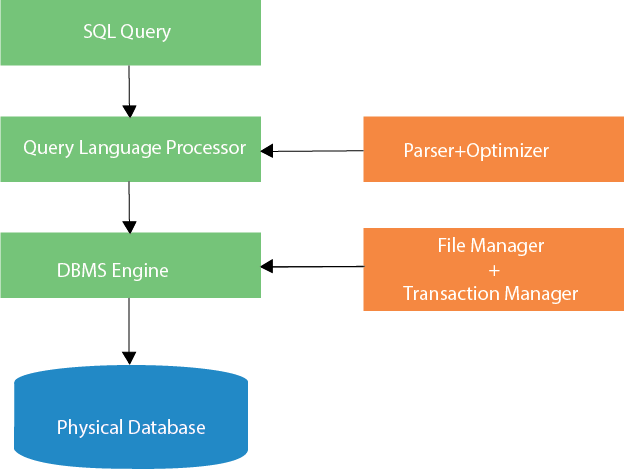
Characteristics of SQL
- SQL is easy to learn.
- SQL is used to access data from relational database management systems.
- SQL can execute queries against the database.
- SQL is used to describe the data.
- SQL is used to define the data in the database and manipulate it when needed.
- SQL is used to create and drop the database and table.
- SQL is used to create a view, stored procedure, function in a database.
- SQL allows users to set permissions on tables, procedures, and views.
Advantages of SQL
There are the following advantages of SQL:
High speed
Using the SQL queries, the user can quickly and efficiently retrieve a large amount of records from a database.
No coding needed
In the standard SQL, it is very easy to manage the database system. It doesn't require a substantial amount of code to manage the database system.
Well defined standards
Long established are used by the SQL databases that are being used by ISO and ANSI.
Portability
SQL can be used in laptop, PCs, server and even some mobile phones.
Interactive language
SQL is a domain language used to communicate with the database. It is also used to receive answers to the complex questions in seconds.
Multiple data view
Using the SQL language, the users can make different views of the database structure.
Labels: Data Base Management System, DBMS Unit-2
Discussion & Queries (<$I18NNumComments$>):
<$CommentPager$>
- <$I18NAtCommentTimeWithPermalink$>, <$I18NCommentAuthorSaid$>
<$CommentPager$>
<$BlogCommentBody$>
<$BlogCommentDeleteIcon$>